A sensor on the electric grid picks up a strange blip in current or voltage. What’s happening, and will it cause an outage? Usually, a utility worker must travel in person to check. Researchers at the Department of Energy’s Oak Ridge National Laboratory have developed a new automated drone inspection system that can respond rapidly to unusual electric grid behavior, especially in remote areas that are tough for a worker to reach.
ORNL demonstrated the new approach at a training facility for powerline workers owned by utility partner EPB of Chattanooga in Tennessee. A recording of popping sounds, like those made by an arc of superheated electricity, started the exercise. In moments, a drone lifted into the air, following GPS coordinates to check for problems.
Hovering near power lines, the drone filmed the equipment with a tiny camera and then called other drones carrying high-resolution acoustic sensors, radio frequency sensors or other specialized equipment. The drones livestreamed their inspection back to the EPB’s command center and ORNL’s linked Grid Operations and Analytics Laboratory in Knoxville. The drone-mounted sensors can collect enough information for the utility to decide whether to dispatch a bucket truck for urgent maintenance to prevent a power outage.
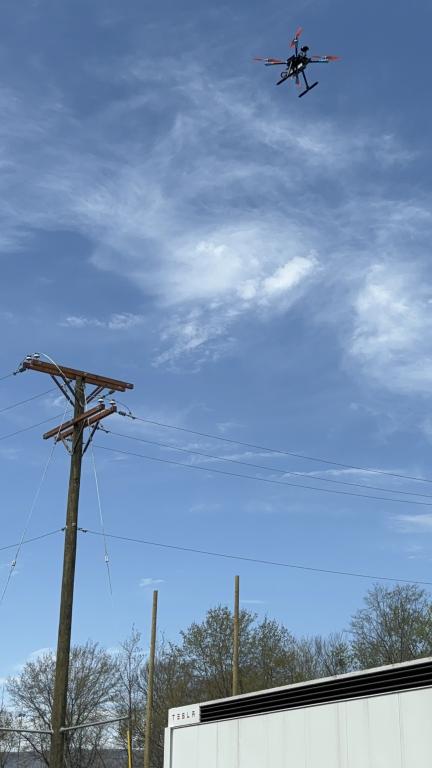
The demonstration proved that humans don’t have to be directly involved with this level of grid monitoring, said lead researcher Peter Fuhr, who also leads the Grid Sensing and Communications group at ORNL. Drone-based sensors could pinpoint problems faster.
EPB is interested in implementing the approach because accurate, early recognition of electric line malfunctions can prevent outages and save money. “The biggest opportunity is identifying imminent equipment failure,” said Jim Glass, assistant vice president of Smart Grid Operations for EPB. “Just as with your health, if you catch problems early, you can correct them with less expense and difficulty. Proactively addressing problems before customers experience outages provides tremendous benefit.”
The automated drone inspection and its technology are part of a collaborative project called Autonomous Intelligent Measurement Sensors and systems, or AIMS, funded by DOE’s Office of Electricity. ORNL researchers developed the system for using machine-to-machine communications to automatically sense problems, generate work orders and coordinate multi-stage drone inspection of electrical transmission equipment. The project also supports processing the drone data and images so they are useful in rapid decision making.
AIMS customizes off-the-shelf drones, sensors and software along with new technology, algorithms and automated protocols developed by ORNL. Using commercial technology when possible makes the approach practical and affordable for electricity providers.
“This is completely novel to the utility world,” Fuhr said. “No one has put this together as a holistic system before. We’re taking these components and operating them in a very different way, tailoring the math, hardware and software to the needs of utilities.”
In the cases when commercially available products were not affordable for use across a utility system, the ORNL team designed new technology. For example, ultraviolet cameras for the drones were priced at $25,000 and weighed 10 pounds. ORNL researchers invented a combination visual/ultraviolet/invisible light sensor that’s less than 1 percent of the cost and weighs less than a pound, Fuhr said.