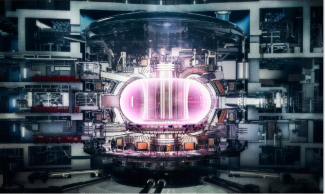
Delivering energy from fusion is considered one of the most significant challenges for engineering in this century. Fusion power has been successfully achieved for limited periods of time, but the operating periods, plasma performance, and output power levels needed for energy delivery remain to be demonstrated. To support an essential step towards fusion energy, the international ITER project will demonstrate an industrial-scale 500 MW long duration burning plasma. The ITER facility is under construction in southern France, with tokamak assembly now underway. Components are arriving regularly from all the ITER partners: China, European Union, India, Japan, Korea, Russia and the United States. As an ITER partner, the United States is providing 12 hardware systems that are essential for meeting the fusion science and technology goals of ITER. These include superconducting magnets, microwave and radiofrequency based plasma heating systems, and high temperature plasma measurement systems that span the electromagnetic spectrum.
Dr. Rasmussen is the leader for the technical integration of US ITER Project contributions to the ITER fusion project, currently under construction in France. His areas of responsibility have included the ITER plasma heating and fueling systems. He has been a plasma research scientist at Oak Ridge National Laboratory since 1981. He has more than 35 years of fusion and plasma science experience in diagnostic measurements and the technology development needed for magnetic confinement fusion and other plasma technology applications. He received a Ph.D. in Applied Science, specializing in Plasma Physics, from the University of California at Davis in 1981 where his graduate work was a study of inertial laser fusion wave plasma interactions.