A critical-materials recycling technique pioneered at Oak Ridge National Laboratory by researchers in the Department of Energy’s Critical Materials Innovation Hub, or CMI, recently earned special recognition from the journal Advanced Engineering Materials, and the associated research project received a new phase of funding for research and development.
The journal selected a paper about the technology for its collection of the most outstanding articles published throughout the past year. The article, featured on the journal’s front cover, explains how the researchers applied the team’s membrane solvent extraction, or MSX, method to recover, separate and purify rare earth elements, or rare earths, from scrap permanent magnets taken from electronic waste.
Permanent magnets, which retain magnetic properties even in the absence of an inducing field or current, are used extensively in clean energy and defense applications. Rare earths are challenging to access because they are scattered across Earth’s crust, yet they are key components in many modern technologies. Recycled rare earths can be used to make new permanent magnets, accelerate chemical reactions and improve the properties of metals when included as alloy components.
“The editors chose the paper because it demonstrated the scalability and secure, long-term performance of the process,” said ORNL scientist Syed Islam, who co-invented the recycling approach and led the collaborative scale-up efforts. “Our industrial partner Momentum Technologies performed a technoeconomic analysis of all the inputs, extracting chemicals, membranes and lifetimes of the materials. Additionally, they validated that the process recovered more than 95% of the rare earth product at greater than 99.5% purity.”
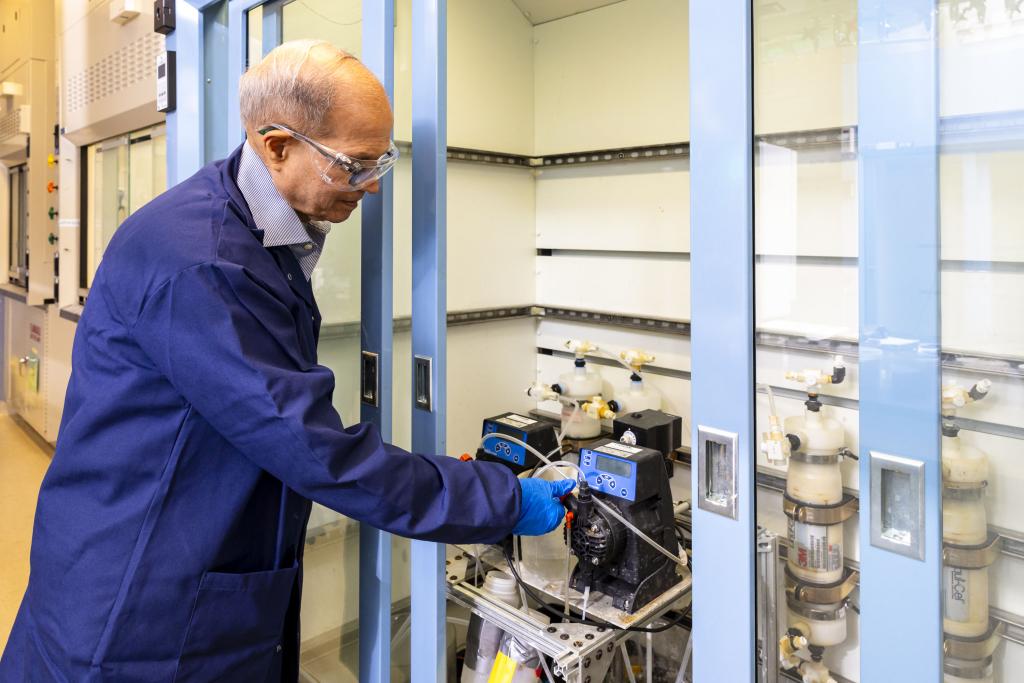
ORNL’s Ramesh Bhave, the project’s principal investigator since it began in 2013 and a co-inventor of the technology, commented on the article’s exceptional thoroughness. “It discusses a full range of aspects of the process along with the results, so the reader gets a complete story,” he said. “We had enough information from this research for many papers but wanted to ensure the integrated process was provided so the reader could see how it is applicable to a large number of materials for recycling.”
Efficient, versatile recycling
The process uses modules composed of polymer hollow fiber membranes that are inexpensive and commercially available.
In the first step of the process, scrap magnets are crushed and dissolved in a mineral acid. The resulting solution is then continuously fed into the membranes where the rare earths are selectively removed by the extractant and form a so-called complex.
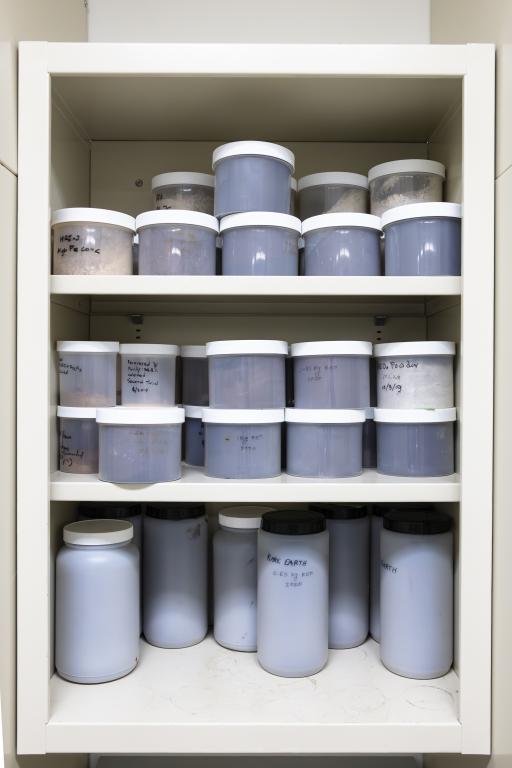
The complex passes through the membrane and meets with a solution that isolates the rare earths to form a rich solution that is converted to rare earth oxide powders, which are suitable for a wide range of industrial applications. Iron, a non-rare earth, is collected separately as a co-product.
“Compared with alternatives such as hydro-metallurgy-based solvent extraction, our MSX method uses fewer chemicals and costs 100 times less," Bhave said. “The technique is advantageous for other reasons as well: It is scalable and works at low temperatures and low pressure. It recycles acid and water and generates minimal waste to promote a circular economy. MSX requires low capital and operating costs. Moreover, it is robust and versatile, with the ability to process a wide range of complex feedstocks.” Feedstocks are the raw input materials for the recycling process.
Pure recovery, seamless repurposing
Bhave said that MSX can recover and recycle high-purity cathode-active materials to meet the manufacturers’ specific requirements for the creation of new products. Cathode-active materials are a crucial part of a lithium-ion battery’s structure, responsible for the flow of electric current and energy storage.
The researchers have demonstrated that by adjusting the chemistry and adding stages to their technique, they can individually separate and recover cobalt, nickel and lithium from battery waste.
To supply the project with the necessary raw materials, Momentum Technologies takes lithium-ion batteries from end-of-life items, such as electric vehicle systems and cell phones, and crushes them together to create a powder, called black mass, which is fed into the recycling process. The individual critical elements — cobalt, nickel and lithium — are removed from the black mass in stages.
“The greater-than-99% pure material resulting from the process can be combined to make new lithium-ion batteries with our industry partner,” Islam said. “Again, as was the case with rare earths recovery, a major advantage of our approach is scalability. For example, should the demand for the recycling of battery metals for a particular product suddenly grow, the number of membrane modules can be increased for a greater volume of output.”